

A credit facility that could exceed $10 billion
Reuters reported on August 18, citing Bloomberg, that Anthropic is assembling a major revolving credit facility as preparations for its public listing move forward.
The target is roughly $10 billion, but commitments offered by financial institutions could push the total higher. Bloomberg says banks taking the most active roles in arranging the facility have been asked to commit around $1.25 billion each, with a second tier encouraged to provide roughly $1 billion and less active participants offering $750 million or less.
The number is not final. Negotiations are continuing, and Anthropic could ultimately cap the facility at its original target or even below it.
One distinction is essential: a $10 billion revolving facility does not mean Anthropic has just raised or immediately spent another $10 billion. A revolver primarily provides borrowing capacity that a company can draw according to its needs and the terms of the agreement.
The banks are competing for more than interest payments
The most revealing part of the transaction may sit on the lender side. Bloomberg reports that banks are actively competing to participate because they hope their involvement will strengthen their case for a role in Anthropic's IPO.
That is a familiar capital-markets dynamic operating at an unusual scale. A company going public needs banks to structure the offering, distribute shares to institutional investors and manage the listing process.
For a flotation that could rank among the largest ever attempted, winning one of those positions could be extremely valuable.
The credit line therefore becomes a kind of Wall Street audition as well as financing: lending today can demonstrate a bank's ability to mobilize capital and improve its chances of becoming indispensable tomorrow.
The IPO is no longer hypothetical
Anthropic confidentially filed for a U.S. initial public offering in June. The company has not publicly disclosed the planned number of shares, pricing or ultimate size of the deal.
A confidential submission allows a company to advance part of the process without immediately exposing all of its sensitive financial information to the public and competitors.
Going public would move Anthropic from a company funded primarily by private investors and strategic partners into one whose performance is scrutinized continuously by public markets.
And the scale it has reached before making that transition is already difficult to compare with that of a conventional startup.
Anthropic was already valued at $965 billion in May
On May 28, Anthropic announced a $65 billion Series H funding round that valued the company at $965 billion post-money.
Only a few months earlier, a $30 billion Series G in February had valued it at $380 billion. The scale changed so quickly that the methods used to price the company have almost immediately had to change with it.
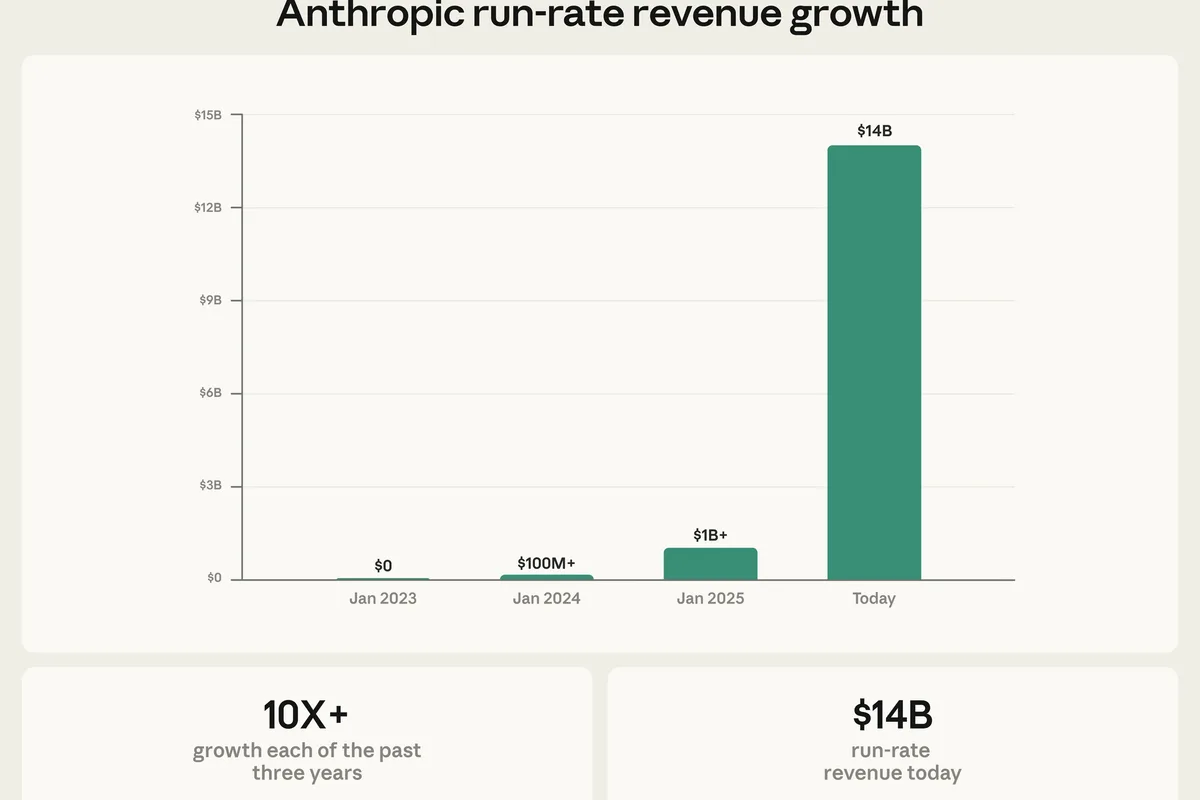
The chart above, published by Anthropic alongside its February funding round, illustrates how quickly even the company's own growth snapshots become dated. It highlighted a $14 billion annualized revenue run rate. By May, Anthropic publicly said that run rate had already crossed $47 billion.
Reuters now reports, citing a person familiar with the matter, that the annual revenue run rate exceeded $65 billion by the end of July.
The identical numbers should not be confused. Anthropic raised $65 billion in equity financing in May, while the more than $65 billion figure reported for July is an annualized revenue run rate. They are entirely different financial measures.
Wall Street has to price a company changing too quickly
That is precisely the challenge facing the IPO. Reuters reports that Anthropic is internally projecting roughly $190 billion to $200 billion in 2028 revenue and that those forecasts are playing an important role in valuation discussions.
Those numbers are not a public promise from Anthropic. They come from sources speaking to Reuters and describe assumptions being used as part of the financial process.
Looking that far ahead illustrates the problem. A valuation based mainly on current results could become obsolete quickly if the growth continues, while a valuation built around 2028 requires investors to pay today for an enormous amount of expansion that has not happened yet.
That is one of the paradoxes of the planned listing. The faster Anthropic grows, the harder it becomes to decide what the company is actually worth at the precise moment its stock begins trading.
Behind the revenue, AI still consumes extraordinary amounts of capital
Explosive revenue growth does not eliminate financing requirements. Anthropic has to pay for new model training, inference, highly specialized talent and, above all, computing capacity now measured in gigawatts.
When announcing its Series H, Anthropic said it had signed agreements with Amazon for up to five gigawatts of additional capacity, with Google and Broadcom for five gigawatts of next-generation TPU capacity, and with SpaceX for GPU access through Colossus 1 and Colossus 2.

Anthropic also says Claude is available through all three of the world's largest cloud platforms, with AWS remaining its primary cloud provider and training partner.
That infrastructure requirement helps explain why a company reporting tens of billions of dollars in annualized revenue can simultaneously seek private equity, infrastructure partnerships, bank credit and ultimately public capital.
The listing will also test the financial story surrounding AI
Until now, private investors could accept extraordinary valuations through negotiated funding rounds involving a relatively limited group of parties. A public listing changes the nature of the test.
Financial results will have to be reported regularly. Public markets will be able to compare growth, spending, margins and financing requirements quarter after quarter. A distant forecast of $200 billion in revenue will not support a valuation indefinitely if the actual trajectory starts moving away from it.
That is why Anthropic's IPO could matter beyond one company. It would give markets one of their first major public tests of how much investors are truly willing to pay for a frontier-model business once enormous infrastructure costs become as visible as enormous revenue growth.
The $10 billion facility is therefore a signal as much as financing
For Anthropic, a huge revolver would provide financial flexibility while the capital requirements of expansion remain substantial.
For banks, it provides a place at the table before the IPO. For future shareholders, it is another reminder that an AI company can grow at an almost unprecedented speed while continuing to require capital on an industrial scale.
The facility's final size has not been settled, and Anthropic has not publicly commented on the Bloomberg report cited by Reuters. A negotiation should therefore not be treated as a completed transaction.
But the fact that a credit facility of roughly $10 billion can now be considered part of the preparation for Anthropic's listing already says something about the scale of the company. Wall Street is no longer treating Claude as the promising product of a startup. It is preparing to finance a company that intends to enter the public markets among the giants.